Showing posts with label subway. Show all posts

Friday, August 7, 2026

malbone street and the true genius of vince gilligan


Great storytellers borrow from history. Great storytellers borrow so well that you don't even realize they're doing it. Which raises an interesting question: did Vince Gilligan draw inspiration for one of the most memorable tragedies in the Breaking Bad universe from New York City's worst transit disaster?

Hear me out.

On November 1, 1918, the deadliest subway disaster in New York City history occurred beneath what was then Malbone Street in Brooklyn. The official explanation is familiar enough: a strike left the Brooklyn Rapid Transit Company desperately short of qualified personnel, so they put dispatcher Edward Luciano—a man with virtually no experience as a motorman—in charge of a rush-hour train. The train entered a sharp curve at roughly five times the speed limit. The result was catastrophic. More than ninety people died. Historians point to a perfect storm of bad decisions: inadequate training, poor management, an improperly assembled train, wooden cars, and an unforgiving curve.

But there is one detail that has always stood out to me.

Just days before the wreck, Luciano's three-year-old daughter had died during the Spanish influenza pandemic. He himself had recently been ill. Whether his grief affected his performance is impossible to know, and historians are careful not to overstate the point. It was one factor among many -- not the cause of the accident, but possibly a cause

Fast-forward ninety years.

In Better Call Saul and Breaking Bad canon, Jane Margolis dies of a heroin overdose. Her father, Donald Margolis, an air traffic controller, returns to work while still overwhelmed by grief. Distracted, he makes a catastrophic error that results in the midair collision of Wayfarer 515 and another aircraft over Albuquerque. It's one of the defining tragedies of the Breaking Bad universe.

Now ask yourself...

A transportation operator.

Grieving the recent death of a daughter.

Returns to work before emotionally recovering.

Makes a tragic mistake.

The mistake kills large numbers of innocent people.

Coincidence?

Maybe.

But what if Vince Gilligan was quietly borrowing a page from one of New York's greatest transportation disasters?

Gilligan is famous for planting obscure historical references and constructing elaborate chains of cause and effect. The Wayfarer crash wasn't just random tragedy—it illustrated how one seemingly private event could ripple outward until strangers paid the price.

That's also, in a way, the enduring lesson of Malbone Street. The wreck wasn't caused by one person's grief any more than it was caused by one curve in the track. It was a cascade of failures: corporate decisions, inadequate training, unsafe equipment, labor unrest, bad luck, and perhaps one exhausted young man who never should have been handed the controls in the first place.

So no, I'm not actually suggesting Vince Gilligan sat down with Brian Cudahy's The Malbone Street Wreck while outlining Season 2.

I'm just saying...

Has anyone ever seen Edward Luciano and Donald Margolis in the same century?

Monday, February 16, 2026

you always remember your first subway map

Last year the subway system introduced a new map — or perhaps it had already begun phasing it in before 2025 and I only noticed when the old one had mostly disappeared.

That old one — the map that replaced the 1972 Vignelli diagram — had been with us since 1979. Designed by Michael Hertz Associates, it became simply the subway map. It lasted more than forty-five years.

And yet, to me, the definitive New York subway map is still the Vignelli map.

Which is odd.

Because it was only in use for seven years.

Abstraction

The Vignelli map was beautiful — provided you already knew where you were going.

If you knew you needed the F to West 4th Street, it was perfect. The design was schematic, rational, almost electrical. Lines ran at 45- or 90-degree angles. The subway looked like a circuit board. It felt solvable.

It treated the subway as a system.

It did not treat New York as a city.

Distances were abstract. Central Park was a tidy shape. Boroughs were compressed or widened. Landmarks were mostly absent. If you were trying to understand where things actually were in relation to each other above ground, the map could mislead you.

I learned that the hard way.

Woodside and the Popsicle Sticks

Still during the Vignelli era, I decided I needed to go to an art supply store in Woodside to buy popsicle sticks for some craft project. I don’t remember how I figured it out, but I determined which stop on the 7 train was closest and concluded that it would be a short walk.

The map seemed to confirm this.

I got off the train and started walking.

And walking.

And walking.

Eventually I reached the store and bought my popsicle sticks, but the walk was much longer than I had anticipated. The map had flattened distance. Stations that appeared neatly spaced were not, in fact, equidistant in real life. And Queens, with its relatively sparse subway coverage compared to Manhattan, has a way of stretching space between stops.

The Vignelli map had made the trip look like a hop.

Reality was a hike.

It was a beautiful system diagram. It was not a pedestrian guide.

The Hertz Correction

The 1979 redesign tried to fix that. The Hertz map overlaid the subway lines onto something resembling actual geography. Shorelines curved. Subway lines curved. Parks looked like parks. You could approximate direction and distance.

It also introduced one of the system’s smartest ideas: trunk-line color coding through Midtown Manhattan.

The B, D and F were orange because they ran on the Sixth Avenue trunk.
The N, Q and R were yellow because they ran on Broadway.
The 1, 2 and 3 were red; the 4, 5, 6 green; the A, C, E blue.

The color didn’t belong to the letter. It belonged to the trunk.

Which meant the letters could change color.

The Q has not always been yellow. From 1988 to 2001, when it ran via Sixth Avenue, it was orange. The V —  which existed for just under a decade, from 2001 to 2010 — was orange for the same reason. The M used to be brown, part of the old Nassau Street trunk, before rerouting through Sixth Avenue turned it orange.

Even the Q’s name is historical shorthand. It descends from “QB” (“Brighton via Bridge”), alongside QT (“Brighton via Tunnel”) and QJ (“Brighton to Jamaica”). Historically, the Brighton Line in Brooklyn was the Q. I wish I could end this paragraph with the snarky observation that today’s Q doesn't go to Brighton anymore. But it does.

The W, despite what my memory occasionally insists, has always been yellow. Broadway. My recollections are not immune to rerouting.

The Loss of Purple

As a kid, I did not think in terms of trunk-line logic.

I thought in terms of identity. I thought of the F as my train.

The F used to be purple.

It was a beautiful purple. Distinct. Singular. Royal.

Then trunk-line standardization arrived and the F turned orange, joining the B and D. Meanwhile the E — which I irrationally regarded as a rival — remained blue (though a darker shade).

This felt like betrayal.

I understood that color now signified shared Manhattan infrastructure. But I also knew was that the F had lost something beautiful. The 7 train became purple, and it has remained so ever since.

Clutter and Compromise


The Hertz map’s weakness was the inverse of Vignelli’s. It tried to show everything. Geography. Water. Parks. Bus connections. Street grids. Transfers. It was useful — and sometimes cluttered.

The new map introduced in 2025 appears to be an attempt at compromise. It returns to schematic clarity — strong geometry, simplified layout — while preserving trunk-line color coding. Instead of a single thick orange band in Midtown, multiple orange services run in parallel. It is less geographic than Hertz, more geographic than Vignelli.

It tries to split the difference.

The First Map Is the Real Map

The Vignelli map lasted seven years. The Hertz map lasted more than forty-five.

And yet the Vignelli map is the one in my head.

It was the map in use when I first became fascinated with the subway — when tracing colored lines across boroughs and memorizing station names felt like decoding a secret system. It made the city look legible.

When I was young, I found it odd that the map wasn’t redesigned every few years. Why not refresh it like baseball cards? Why not issue new editions, with completely new designs?

It took adulthood to realize that redesigning infrastructure costs money. Stability matters. A transit map is not a collectible.

It is a working tool.

I’m not entirely convinced the system needed this latest redesign. But maps are arguments about what matters — clarity or fidelity, abstraction or realism, system or city.

In the end, the definitive subway map is the one you first learned to read — the one that made you believe the city could be understood.

Even if it occasionally left you walking much farther than expected for popsicle sticks in Woodside.

Sunday, January 9, 2022

goodbye r32


It's been nearly six decades since the R32 subway car first entered service -- they were running in the system before I was born*. And today is their last day. I believe they've already been taken out of regular service, but the TA is running a few special trains so that railfans and sentimentalists can get ride them one last time. The R32 is my favorite of the cars in active service -- it has been since they took the R33s and R36s (then running on the 7 train) out. As of tonight I won't have a favorite.
The R32 dates back to when subway cars had style and beauty. In my mind that ended with the R42s. Those from the R44 on seem like characterless plastic shells -- cars to be ridden but not enjoyed. I remember once when I was in school, going home on an F train. At that point all the Fs were R46s. At Union Turnpike an E train of R32s pulled in. It surprised me because my Es and Fs had been exclusively R46s. But I got off the F just as the doors closed and ran across the platform to get the E. It would be a longer ride -- at that time the E and F both went to 179th Street in Jamaica, but the F was an express and the E was local. I stood on that train amazed. It seems odd now, but I remember the odd sensation marveling over it. "I'm on a E train, and it's R32s!" Most people probably can't understand it. I hope that some railfans can. It turned out that the TA was just starting to switch things up. R32s were replacing The R46s on the E and F. I have no idea where the R46s were going. I also have no idea why the TA decides to move car types around, but that's another matter. Within a month all the Es and Fs were R32s.

I will always associate the R32s with a few of the models that came later -- the R38s, R40s and R42s -- as representing a specific generation of designs. I don't know of any real reason to associate those few models. Maybe it's aesthetics. The R32s had stainless steel exteriors, while the predecessors didn't. That feature was carried over to the 38s, 40s and 42s. The R44s and R46s were very much a departure designwise, so I think of them -- whether rightly or wrongly -- as representing a new generation. And I didn't like the new generation. They seemed all plasticy and fake. And the motorman's cab spans the full width so it's not as easy or fun to look out the front window. I will acknowledge that it's probably more comfortable for the motorman and conductor.

But of its generation, I like the R32s the best. The R40, with its sleek slant end, had a certain unique style --even if they had to change that for safety reasons. And I liked the windows in the doors at the ends of the slant-40s. They went down low enough that even a young short railfan could experience the rush of standing at the front window as the train barreled along. But those seats! The R40s and R42s had the most uncomfortable seats in the system. The back was straight and angles badly, with the top being low enough to make it even worse. I never wanted a seat on those cars. The R38 was fine -- I have nothing bad to say about it. But I just never warmed up to it the way I did the R32. That may be because I didn't ride them as much. There were fewer in the system. That said, the corrugated exterior of the R32, with its tighter crinkles that go all the way up, was just more attractive than the wider crinkles that went only halfway up the side of the R38.

For a lot of my life the F train (and for a while the E too) was my home line. The R46 is the subway car that I most associate with the F. of course, it wasn't always R46s. My earliest subway memories -- going to elementary school -- include cars in the R1-9 series, and of course I remember R32s and others. Now they us cars that are post-R46 -- cars whose model numbers I don't really know

I thought about heading to Brooklyn to take one of those final rides. At another point in my life I definitely would have. But none of my kids is interested, though Ethan said he would go if I really wanted him to. It's not something Blair really wants to do, but she said she's go and have a good time if I wanted to. Still, I'll skip it. I suspect it will be crowded, and I won't get a spot by the front of back window. So sometime late today I'll think about the R32. In my mind I'll raise a toast to a great subway car and a bygone era.

Sunday, September 12, 2021

new transfer -- a first


Recently the subway system opened up a new free transfer between Times Square (N,Q,R,S,W,1,2,3,7) and 42 Street/Bryant Park (B,D,F,M). Essentially, this is a connection between Seventh Avenue and Sixth Avenue, along 42nd Street.

I note that the Times Square station is already connected by free transfer to 42 Street/Port Authority Bus Terminal (A,C,E) and the 42 Street/Bryant Park station is already connected by free transfer to the 5 Avenue station (7). This means that, without leaving the system you can go along 7th Avenue from 8th Avenue to 5th Avenue. Those are three long blocks. I doubt the system has any other transfers covering such a distance.

But what makes this really interesting to me (and the reason I am writing this post) is that you can now get a free transfer between the 7 train at Times Square and the 7 train at 5th Avenue. I am reasonably sure that this is the first ins-system transfer between two stops on the same line.

Monday, April 5, 2021

back on track

One year, one month and one day. 397 days. That's how long I went between subway rides.

On March 4, 2020, I took the subway to work and then took it home again. I didn't realize how long it would be before I went underground again. The pandemic was underway, and we had some concerns. At the office the WeWork staff were constantly wiping down surfaces, and the communal snack dispensers were empty. Blair was expressing fear regarding my daily commute, and suggesting I avoid touching the stanchions on the trains, and maybe adjust my schedule so that I'd be commuting in less-crowded trains. But as I headed home that night, I was still fully expecting to be coming back in the morning.

But the company contacted us that night -- one of our coworkers had been exposed to someone who had caught COVID, so we were to work from home on the fifth. At that point, we were still expecting this be a short interruption. I don't remember the exact sequence of decisions and communications. Suffice to say that originally we were expecting to be back in the office in less than a week. More than a year later I don't believe there's any clear timetable. I'm still working from home five days a week. and have not been back to the office.*

We have made trips into Manhattan since then -- mostly for dental appointments. In normal times, we would take the subway into Manhattan. But since the pandemic hit we've driven in. Aside from the risk of getting COVID, we've heard that it had become harder to avoid unstable and/or dangerous people on the subway. So, if Blair has an appointment, I'd drive her in, and sit in the car by a hydrant while she goes to the office. And she does the same for me.

And, as time marched on, we got used to this new way of doing things. On March 4, I sadly noted the anniversary of my last subway ride, without a change in sight.

To most people, this wouldn't be a big deal or a bad thing. But when I was a kid, there was a stretch where I took the subway to school every day. And I became enamored of it. I studied the maps, the history of the system, anything. In high school, I had to take the train to and from school, and my interest in the system intensified. I was in the school's subway club. I set aside one afternoon a week to ride a line that I hadn't before. There was a stretch of time that I had my bedroom set up like a museum, with all my subway memorabilia on display. Well, most of my memorabilia, anyway -- the huge "125th Street" sign that had once hung from the ceiling of the 125th Street (and Eighth Avenue) station was too big and heavy for my room, and so was hanging on a fence in the backyard. My parents refused my request that they let me buy a vintage R-1 car and store it in the backyard.

I was a bout a year old when my family moved to New York. Except for the aforementioned year or two where I rode the subway to elementary school,  I wasn't a regular on the trains until high school. So I'm sure this wasn't the first time I went a year without riding the trains, but you'd have to go back at least as far as the 1970s to find such a stretch.

Today marked my return.

I had a dental checkup. Blair offered to drive me in as usual, but she would have had to change her physical therapy schedule. So, appreciating her willingness to drive in with me, I decided to go back to the train. I should note two facts that played a big role in the decision: 1) I got my first COVID vaccine last week, and my understanding is that leaves me much less vulnerable to the virus than when I was unvaccinated; and 2) My understanding from people who are riding the subway again is that it's tamed down quite a bit.

My return to the underground was familiar yet strange. It was also much more of an emotional event than I would have expected. The ride seemed much quieter than I remember. Perhaps people were deferring to the multitude of signs advising people not to talk. It seemed that there was much less crowding as the doors opened and closed. And people were much more very aware of distance, as they chose whether to sit -- they left empty spaces between each other.

Grand Central seemed eerie in its quiet. It wasn't empty or deserted, but the energy was all off. And most of the vendors were absent. I couldn't simply stop and gab a black and white cookie, despite this being Frank Gorshin's birthday.

And let's not forget Mitu Busuioc. Busuioc is a fixture of the passage between the F and 7 trains at 42nd Street. An accordianist, he's part of the Transit Authority's "Music Under New York" program, which I guess means he's an officially sanctioned busker. I've walked by him numerous times over the years, and as far as I can recall, he was always playing fast happy tunes. Today he was playing a dirge.

But what struck me the most was how much of my subway memory was gone. If I'm going to transfer from the F to the 7 at 42nd Street, which end of the F do I want to be on? If I'm taking the 7 train Eastbound, what end do I want to be on to get out into Grand Central Terminal. These and similar questions were second nature to me a year ago. But today I had to stop and think. And I got some of them wrong.

I don't like being so out of touch with a system that is such a part of me.

_______________________

*As a side note, I won't be returning to the same office. The WeWork space was intended to be temporary, as they refurbished our "real" office.

Saturday, April 27, 2019

farewell r-46

According to an article in Gothamist, the R-46 subway car is set to be replaced starting next year. The article, which is here, isn't really a news item about the impending retirement. It's more a reminiscence about the iconic cars.

I have mixed feelings about the news (which, I admit, is more than most people would have; most people wouldn't care at all). I took the subway to high school. For most of that time the R-46's, which were the newest cars in the fleet, were being used on the E and F lines. As an aside, they were running R-10's on the LL so my morning commute included both the oldest and newest cars in the fleet. The 46's offered a smoother, quieter ride than the other trains that were being used at the time. I guess most other passengers preferred that, but I was a bit too much of a railfan, and I wanted to feel that I was on a subway train.


The R-46 (and the R-44 which was very similar) were a big change from the cars that preceded them. Most notably, they were 75 feet long. Before them, the longest cars the system had ever used were the 67-foot AB Standards, the last of which were retired in 1969. Other cars being used at the time  on the IND and BMT lines were 60 feet long. In preparation for using longer cars, the Transit Authority had to run extended probe trains to see where curves were too tight, and excavate extra tunnel. I wouldn't be surprised if there are still some old BMT tunnels that can't accomodate these trains.

As a consequence of the cars' length, the doors at either end were kept locked for safety. It was felt that the gap was too dangerously wide when the train went around curves. Now people couldn't coross from one car to another in search of seats (or to escape the homeless and insane). Also, it was no longer possible to simply ride between cars -- which is something I used to enjoy doing when the cars were very crowded. Don't tell my mom. Because the doors were locked, these cars didn't have the protective gates that extended the sides between cars. That made them look more attractive, but advocates for the blind objected that they represented a hazzard -- blind people could mistake the space for doors and get killed. I don't know the details of how that dispute went, but the gates were never installed, so I can draw some conclusions.

Inside, the trains brought back transverse seating. Instead of the seats being simple benches along the sides of the cars, these had some seats facing forward and some facing backward. That created more seating, but reduced the total capacity. FWIW, the transverse seats on the R-46s were better than the ones n the R-44s because of the armrests. In the R-44s the arm rests were cut out of the wall but had overhangs, making them uncomfortable. On the R-46's there weren't overhangs. So they didn't look as cool but were more comfortable.

One feature that railfans hated (but that motormen probably loved) was the enlarged cab. Until then, the cabs were relatively small and cramped. That left room for doors to cross through and (more to this point) stand at and look out of. Railfans loved to stand at the front of the train and look out the front window as the world whooshed by. With the R-46's car-width cabs, you couldn't do that anymore. And that change seems to have been carried over to the newer cars -- even though other changes such as transverse haven't been reproduced in more recent models.

The bottom line? I never cared for the R-46s. But a part of me feels bad about the dissapearance of another part of my youth.

Sunday, December 30, 2018

subway dream fulfilled

In the last week I finally finished a quest that began more than forty years ago...I have ridden the New York subway to everywhere it goes.

There were a couple of years in elementary school that I had to take the subway to school, and that was when the interest was sparked. But I generally shared that ride with my father and sister, and it was a relatively short ride in a relatively safe part of the city. I was too young to go off on my own riding everywhere the system went. But the itch had begun.

In high shool, living in Eastern Queens and attending high school in Manhattan, I had my first taste of the freedom to ride to subway on my own, unsupervised. The optimal route had me taking the F train to 14th Street and transferring to the LL (which is now the L), but I made a point of taking other routes -- the E to the LL, the F to the GG (now the G) to the LL, the F to the 7 to the 4, 5 or 6 to the LL...there were a few others. And there was a stretch where, on Wednesdays I would take a train to Brooklyn to ride a route that I'd never been on before. But in that time, I didn't go on most of the routes in the Bronx -- This was the late 1970's and early 1980's, and there were areas that were unsafe.

Since then, there were a few more places that I have gone (e.g., Yankee Stadium), and I went on some of the new routes that have opened since my high school years.

So, going into the end-of-year season, I was missing most of the Bronx, the 2 and 3 trains north of 110th Street, and the 2nd Avenue line north of 72nd Street. And, for some reason, I decided that, while taking a few days off work, I would finally get to these places. I did it in three afternoons, one of which was with Ethan. I could have pushed myself and done it in one, but I wanted to be able to enjoy the experience -- not be thing "Geez, when will it be done?"

Railfanning isn't as much fun as it was when I was a kid. Back then, the motorman's cab only took up about a third of the width of the car. So you could stand by the front door and look through the window. On the newer trains, the cab takes up the full car width. It's much better for the motorman. But now the best you can do is look through the door into the motorman's cab and see through to the door in front of the car. You don't get the same wide angle, and you don';t feel the same closeness to the space in front of the train. For a taste of what real railfanning was like, watch this video that someone took on an A train going from 207 Street in Manhattan to Rockaway Park. It was taken on an R-32 subway car, which is significant because the R-32s had passenger-accessible front windows. Most of the route is underground, but at around 72 minutes it emerges. The remainder of the ride -- especially the parts as it approaches and goes through Jamaica Bay -- is one of the most scenic sections of the system. I watched it at 2X speed.


I won't bore you with the exact itinerary. Instead, I'll bore you with a few observations from the trips.


  • The D train in the Bronx is very boring.
  • The 5 train, out to Eastchester/Dyre Avenue, is a relatively interesting ride, as a good part of it runs on an embankment. So you see lots of varied scenery, including people's backyards.
  • I wasn't aware that the northern terminal of the 3 train in Harlem is above-ground. The 1 train has elevated stretches in Norther Manhattan, but I thought that was it for elevated subways in Manhattan.* It was fun to see that station, though it could definitely use some maintenance.
  • When the 2 and 3 trains split from each each other, north of the 135th Street station, the downtown 2 track crosses the uptown 3 track. Most other places where routes split one or more tracks are graded downward or upward so that they go under and over each other. Building tracks and tunnels the way they did for the 2 and 3 trains is cheaper, but it makes the signalling more complicated and crashes more likely. That said, I am not aware of there having ever been any train crashes at that spot. The only other place I can think of where tracks cross each other like that (and I'm limiting this to tracks that are used in customer service in the New York subway) is just west of the Myrtle Avenue station on the J and M trains.
  • On the 2 train in the Bronx, I kept my eyes out around the Gun Hill Road station to see if any remnants of the old 3rd Avenue el (AKA the 8 train) were visible. That train was discontinued in 1973, so I wouldn't really expect to see anything anymore. On the other hand, the old MJ train was discontinued earlier (I think in 1969), and its trestle is still clearly visible over the aforementioned Myrtle Avenue station that services the J and M. Anyway, I couldn;t make out any infrastructure that I could say for sure was part of the old el. North of the Gun Hill Road station, it looked like the trestle had room for what had at one time been extra tracks. But I don't know if that was related. Did the old el  merge with the White Plains Road line at Gun Hill Road? Or did it kind of hit it at a perpendicular?
  • Most of the routes that I polished off were old IRT lines. They are, in parts, deliciously twisty.
  • The Second Avenue line (or at least what's been built and opened of it) is beautiful, clean and roomy. And boring. WHy did they build it as a two-track line, instead of a four track line that allows for express service. A bajillion years from now, when it's finally extended southward, they'll regret building it as a local only. Maybe -- just maybe -- they actually dug a four track tunnel, and the express tracks are on an as-yet-unopened lower level? It sounds crazy, but when the Lexington Avenue/63rd Street station opened on the F train, there was one track on each level, and the platforms were half-width. There were no visible clues that there was room for another half platform and track on the other side of the wall.

Having said all that, I note that some stretches of subway route have been shut down during my lifetime, and I will never get to ride those. These include (but are not necessarily limited to):

  • The Culver Shuttle (which connected the old Sea Beach line (now part of the D) to the Culver line (now part of the F) in Brooklyn.
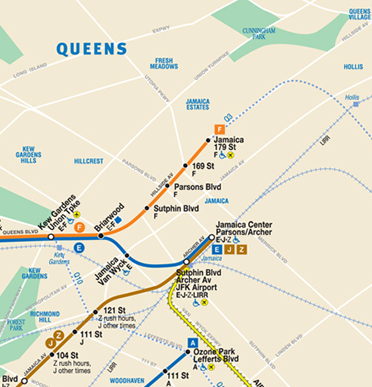
  • The old end of the QJ** (now the J) in Queens. When I was a kid, the QJ, went to 168th Street and Jamaica Avenue. It was shortened to 121st Street. Since then it was extended on a route similar to the old one. It ends underground at Parsons Blvd ("Jamaica Center," whatever the fuck that is). The old line was elevated the whole way.
  • The aforementioned 8 train in the Bronx, which was the last remnant of the Third Avenue el.
  • The aforementioned MJ in Brooklyn, which was part of the BMT's Myrtle Avenue line.

Mission Accomplished
.
*I am not counting the short stretches where trains come above-ground for the Manhattan and Williamsburg bridges.
**Trivia: QJ stands for Brighton to Jamaica.

Wednesday, July 18, 2018

rerouted e -- or simply f?

There's something I don't understand about the E and F subway lines in Queens.

By way of background, for the non-Queensians, the E and F trains end (or begin, I suppose, depending on your perspective) their runs in Jamaica. After leaving Manhattan, they both follow a trunk line under Queens Blvd. Just past the Briarwood Station (which purists among us still call the Van Wyck Blvd. Station) they part course. The E goes to Jamaica Center while the F goes to 179th Street.

The E train goes closer than the F to my office in Manhattan, but the 1479 Street terminal of the F train is my home station. So on days that I work in Manhattan ("the city" in local parlance), my return commute starts with an E train but I switch to an F -- usually at Union Turnpike.

But sometimes an odd thing happens. The E train will get rerouted over the F line and go to 179th Street. When that happens, I feel like I've hit the jackpot. Instead of having to get up and wait for another train, I get to stay on the one that I'm already on. Of course, lots of other commuters are annoyed at the inconvenience for them But that's their problem.

Anyway, when the rerouting happens, we are notified by an announcement from the conductor along the lines of "This is an E train running over the F line. For Jamaica Center, please wait for the next E train." What I don't get is why they insist on calling it an "E train running over the F line" rather than an F train. Once the rerouting has occured, the train is effectively an F.

And it's not just a pedantic point I'm making. There are many immigrants in the area, some of whom aren't native English speakers. I would think that a simple announcement like "This is now an F train to 179th Street" would be easier for people to understand.

ANd don't even get me started on the occasional morning E trains that start at 179th Street...

Saturday, January 14, 2017

nostalgia for an old station name

UPDATED BELOW.

On one of my recent morning commutes I started wondering about one of the stops. "Court Square, 23rd Street" on the E and M lines. I have gone through the station many, many times. In addition to being part of my commute now, the station was part of my regular commute when I was in high school. Only, then it had a different name. Back then it was "23rd Street, Ely Avenue."

And that's what got me to wondering. Some time during my years at my current home, the station changed names, but I can't recall when or why. And the bright mosaics on the station walls still call the place by it's old name. So, why was Ely Avenue banished from the station name? And when did this all happen. And who was "Ely" whose name was lent to an avenue and (for a time) a subway station?

A little research on the intertubes...

The renaming -- which, frankly, I don't remember -- happened in 2011 when free transfers were built to connect the station to the Court Square stations on the 7 and G trains. Didn't at least one of these used to be called "Court House Road" or something like that? Whatever, I've done enough rerearch for the night. As for Ely Avenue, apparently 23rd Street is Ely Avenue. Or was, anyway. It was renamed in 1915 when the Queens Topographic Bureau gave many streets numbers in 1915. What makes this peculiar is that that line wasn't built until the 1930s, so it seems odd to me that they put Ely Avenue in the name.

But what's really sad? I can't find reference to who "Ely" was.

I'll just assume it was Harry Ely. He
was a pitcher for the 1892 Baltimore Orioles.

UPDATE: An old friend from grad school -- Ray Comas -- infoms me that "Ely" is Charles Ely, who developed Hunter's Point in the 1850's. Hunter's Point would merge with other towns to form Long Island City. ALso, I assume that "Hunter's Point Avenue" is named after it. I'm actually kind of disappointed that it wasn't Harry Ely, as I'd sort of gotten emotionally invested in that. But I suppose it was a long shot. Thanks, Ray!