Showing posts with label presidents. Show all posts

Wednesday, February 25, 2026

the alphabetic struggle for the presidency


Political historians tend to divide American history into eras — Founding, Reconstruction, the New Deal, the Cold War, the modern age. These divisions track ideology, party realignments, wars, and economic upheaval.

But beneath those visible shifts lies a quieter contest — measurable, cumulative, and surprisingly dramatic.

The running total of letters in the surnames of Presidents of the United States.

By counting, day by day, the cumulative occurrence of each letter across administrations, a pattern emerges. The results are not random. They form arcs. They show reversals. They reveal consolidation and realignment.

What follows is the verified history of the struggle for alphabetical supremacy.

The Founding Volatility (1789–1825)

The republic begins with N in the lead, thanks to the two N’s in Washington. The early administrations of Washington, Jefferson, and Madison allow N to establish an initial advantage.

That stability proves short-lived.

In 1801, under John Adams, A briefly takes the cumulative lead — the only time in American history that A sits atop the standings. The moment is fleeting. Later that same year, under Jefferson, N reclaims the lead.

The early republic is not yet settled. Margins are small. A single presidency can alter the balance.

In 1825, during the administration of Monroe, O overtakes N for the first time. At this point, it might appear that O’s long reign has begun.

History, however, remains unsettled.

The Nineteenth-Century Tug-of-War

The middle of the nineteenth century reveals a system in flux.

In 1837, under Van Buren, N retakes the lead.
In 1853, under Fillmore, O reclaims it.
In 1857, under Buchanan, N takes it back again.

The margins during this era are narrow, and leadership changes hands through incremental accumulation rather than dramatic surges. No letter establishes durable supremacy. The system oscillates.

This is the Alphabetic Reconstruction Period — unstable, competitive, unresolved.

The Roosevelt Realignment (1933)

The next decisive shift comes in 1933.

Under the second Roosevelt, O retakes the cumulative lead. Unlike earlier reversals, this one holds. For more than five decades, O remains on top.

The twentieth century does not invent O’s strength, but it consolidates it. Coolidge, Hoover and Roosevelt reinforce what had previously been contested ground. From 1933 forward, O governs the cumulative standings with quiet durability.

Other letters rise but do not displace it.

The Eisenhower Acceleration and the E Near-Miss

The closest challenge to O during its long reign came not from N, but from E.

The groundwork was laid by eight years under Eisenhower — the only instance in presidential history in which a single letter appears three times in a surname. No other administration has produced such concentrated orthographic reinforcement.

Those years produced a measurable compression of the gap between E and O. And that continued under Kennedy with his two E's. By the time Kennedy died, E had narrowed the difference to just 32 cumulative occurrences (53,378 to 53,346).

Had Kennedy completed his full term — and, speculatively, a second term — E would have overtaken O for the first time in American history and solidified its lead.

It is tempting to search for deeper significance in that near-miss.

But the data are dramatic enough without inventing motive for the alphabet.

E ultimately settles into a stable third position.

The Modern N Restoration (1987–Present)

In 1987, under Reagan, N retakes the cumulative lead.

This time, it does not relinquish it.

From that point forward — through Clinton, Bush, Obama, Trump, and beyond — N maintains its position at the top. What had once been a volatile rivalry stabilizes into a modern alignment.

As of the projected end of the current term in 2029, the standings are clear:

N: 67,786
O: 65,916
E: 59,190

The margin is not overwhelming, but it is steady.

After nearly two centuries of oscillation and mid-century consolidation under O, the system has returned to its founding configuration — N on top.

What Does This Reveal?

The early republic was volatile. The nineteenth century oscillated. The twentieth century consolidated. The late twentieth century realigned.

These are phrases historians already use to describe American political development.

Here, they apply equally well to cumulative orthography.

It would be irresponsible to claim deeper meaning. The letters accumulate because surnames contain them. The graph rises because time passes.

And yet, when viewed across 240 years, the pattern feels structured. A led once. O governed for decades. E nearly staged a coup. N reclaimed supremacy and has held it since 1987.

History is written by the winners.

Even when the winners are consonants.

Saturday, November 16, 2019

a stoopidstats look at presidential influence on the supreme court

Ethan and I were talking about the Supreme Court and the various presidents' influence on it.

As a result, I came up with a StoopidStats-based way of measuring such influence.It comes down to two statistics:

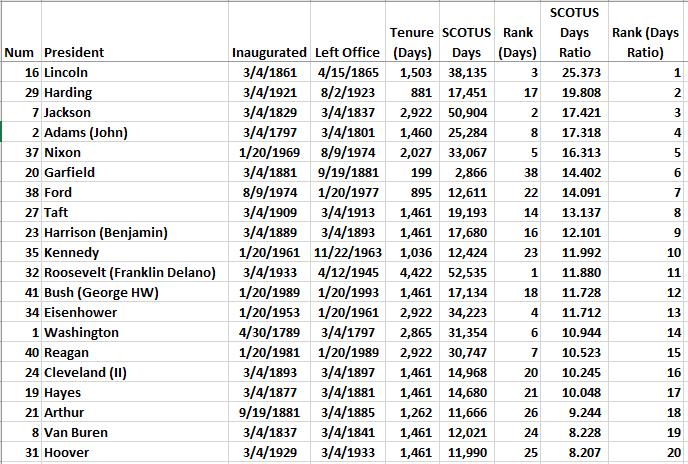
  • SCOTUS Days: Is designed to be a measure of a President's impact on the court without any consideration of how long the President served. It is the total number of days served on the court by justices the president picked.*
  • SCOTUS Days Ratio  measures a president's influence relative to the length of his tenure as President. It is SCOTUS Days divided by the number of days the President served.
The full file is here.


It's not terribly surprising that Franklin Delano Roosevelt has the most SCOTUS Days, with 52,535. He served more than three full terms, which is longer than anyone else, and picked eight SCOTUS justices.  George Washington picked 11 justices -- SCOTUS was a new thing, and he had to pick all the original justices. But they served much shorter terms.

But, while Roosevelt has more SCOTUS Days than any other President, he is 11th in SCOTUS Day ratio, at 11.880. First is Abraham Lincoln, with a ratio of 25.373. He has over 38 thousand SCOTUS Days, resulting from a presidency that lasted a little more than one term.

A few interesting notes:

  • There have been four Presidents who never got to pick a SCOTUS justice: William Henry Harrison, John Tyler, Andrew Johnson and Jimmy Carter. Carter is the only one of those who served a full term.
  • Of those who did pick a justice, John Quincy Adams is the only one whose ratio is below 1. This means that the justices he picked (OK, there was only one) collectively served less time on the court than he did as President.
  • Mahlon Pitney was on the court for exactly 4,000 days.


 * Few notes about methodology. I treated Cleveland's two nonconsecutive terms as separate presidencies. All statistics are as of this coming December 31, with the assumptions that Trump is still President at that point and the makeup of the court remains the same until then.

Thursday, December 27, 2018

a question about president's names

In a Facebook conversation, a friend* posed the following question:
How many Presidential names can form a relatively prime group? That is, no letters in a President's name occur in any of the Presidents' names in the group. I've come up with several groups of three, but no groups of four so far.
Now, that's the kind of pointless thing that really appeals to me, so I had to work it out. Spoiler alert: Three is the maximum.

For reference, I have listed the presidential last names below. There are only 39 of them (despite there having been 45 presidents) because six last names -- Adams, Harrison, Johnson, Cleveland, Roosevelt and Bush) have been repeated.

Here's how I worked it out:

First, for simplicity, I am going to use the initialism, "RPG" to mean "relatively prime group," meaning (as described above) a group of names, no two of which have any letters in common.

I didn't want brute force this, so I started by considering vowels.** There are five vowels, not counting Y, and each presidential name has at least one. That means that, before going on, we know that the maximum size of an RPG is five or less. Assuming there is an RPG of five, it has to consist of the following:

  1. A name with one or more A, but no other vowels
  2. A name with one or more E, but no other vowels
  3. A name with one or more I, but no other vowels
  4. A name with one or more O, but no other vowels
  5. A name with one or more U, but no other vowels
Before going on, let me note that that is a necessary condition, but not sufficient. If, for example, you put together such a group, but two of the names have Ns in them, then that group is still not an RPG.

But examination of the presidential last names (listed below) reveals that there are no presidential last names that have I's but no other vowels. Which means there is no RPG of size five. So now the question is, are there any RPGs of size four?

Repeating the same line of reasoning above, we know that every president's last name has an A, an E, an O or a U. If there is an RPG of size four, it must consist of the following:
  1. A name with one or more A, but no E, O or U
  2. A name with one or more E, but no A, O or U
  3. A name with one or more O, but no A, E or U
  4. A name with one or more U, but no A, E or O
From this point on, I brute forced it. Let's see what there is:

Let's call the names that satisfy condition 1, "set A." Set A consists of Adams, Grant, Taft and Harding

Let's call the names that satisfy condition 2, "set E." Set E consists of Tyler, Pierce, McKinley and Kennedy

Let's call the names that satisfy condition 3, "set O." Set O consists of Polk, Lincoln, Johnson, Wilson, Nixon, Ford and Clinton.

Let's call the names that satisfy condition 4, "set U." Set U consists of Bush and Trump.

Simple examination shows us that Adams is not relatively prime with either element of Set U. Neither Grant nor Harding is relatively prime with any element of Set E. So if there is an RPG of size four, it must contain Taft.

The only element of Set U that Taft is relatively prime with is Bush. So if there is an RPG  of size four, it must contain Taft and Bush.

Turning to the elements of Set E, we can confirm that an RPG of size four can't contain Tyler (since Tyler is not relatively prime with Taft, which must be in the RPG of size four. So an RPG of size four must consist of:
  • Bush
  • Taft
  • either Pierce, McKinley or Kennedy
  • an element of Set O.
Now, which element of Set O could be that fourth item?
  • It can't be Polk because Polk is not relatively prime with Pierce, Kennedy or McKinley
  • It can't be Lincoln because Lincoln is not relatively prime with Pierce, Kennedy or McKinley
  • It can't be Johnson because Johnson is not relatively prime with Bush
  • It can't be Wilson because Wilson is not relatively prime with Bush
  • It can't be Nixon because Nixon is not relatively prime with Pierce, Kennedy or McKinley
  • It can't be Ford because Ford is not relatively prime with Taft
  • It can't be Clinton because Clinton is not relatively prime with Pierce, Kennedy or McKinley
Therefore no element of Set O can be in the RPG of size four, so there does not exist an RPG of size four.

There are, however, several RPG's of size three, including (Bush, Taft, Pierce).

So the maximum size of an RPG is three.

QED.

As an aside, I note that Washington is not relatively prime with any other president's name. FWIW.

Presidential last names (in alphabetical order)

  1. Adams
  2. Arthur
  3. Buchanan
  4. Bush
  5. Carter
  6. Cleveland
  7. Clinton
  8. Coolidge
  9. Eisenhower
  10. Fillmore
  11. Ford
  12. Garfield
  13. Grant
  14. Harding
  15. Harrison
  16. Hayes
  17. Hoover
  18. Jackson
  19. Jefferson
  20. Johnson
  21. Kennedy
  22. Lincoln
  23. Madison
  24. McKinley
  25. Monroe
  26. Nixon
  27. Obama
  28. Pierce
  29. Polk
  30. Reagan
  31. Roosevelt
  32. Taft
  33. Taylor
  34. Truman
  35. Trump
  36. Tyler
  37. Van Buren
  38. Washington
  39. Wilson

*I won't share his name, but it has letters in it
**Credit where due: Blair suggested I look at vowels


Sunday, September 2, 2018

stoopid presidential factoid for the day

Here's a little interesting factoid about the Presidents that I find interesting.

The record for the most consecutive US presidents who have each been elected once and only once is three. That record has been achieved twice:
  1. Cleveland (1884), Harrison (1888), Cleveland (1892)
  2. Harding (1920), Coolidge (1924), Hoover (1928)
That means that the sequence of initials for these for CHC and HCH -- inversions of each other.

Yeah, that's the kind of thing I think about sometimes.

Sunday, April 15, 2018

what makes the trump presidency so interesting?

Thanks to "Pearls Before Swine" (the best comic strip around, IMHO), I realized something interesting about the Trump presidency. Note, by the way, that "interesting" is subjective.


For the rest of this post, I am ignoring the six cases where two presidents had the same last name.*

Trump is the first president whose last name begins with the same four letter sequence as a past president. The past president in question is Truman. Both "Trump" and "Truman" begin with T R U M.

There have been several pairs that began with the same two letters, and one  (Harrison and Harding) that began with the same three letters. But Trump colluded with Truman to up the ante.

Who says these are boring times?

*Adams, Harrison, Johnson, Cleveland, Roosevelt, Bush

Tuesday, February 27, 2018

representing the presidents' names as hillsides

So, I was playing around with numbers and Presidents' names and whatnot, and started wondering about the gematria of these names.

Washington hillside
By way of background, gematria is a type of Hebrew numerology.  Each letter of the Hebrew alphabet has a numerical value. The first nine have the values 1 to 9. The next 9 have the values 10 to 90. The final four have the values 100 to 400. A word's total value is the sum of the values of its letters. For example, the Hebrew word חי, meaning life, has a value of 18. Which is why 18 is a lucky number in Judaism.*

Polk hillside
So, I wondered what the gematria of the various President's last names would be. In order to do that, I had to start by creating values for the letters in the Latin alphabet. In case anyone's interested, the values of the names range from 104 (Obama) to Taylor (1,081).

Roosevelt hillside
Then I started wondering about what it would look like to graph the Presidents' progressions of the cumulative gematria, letter by letter of the names. To explain with a concrete example, let's look at "Taft." "T" has a value of 200. "Ta" has a value of 201. "Taf" has a value of 207. "Taft" has a value of 407. Of course -- and I should have thought of it before I started -- these graphs all kind of look like cross sections of hillsides. Or cumulative probability functions (assuming you normalize to a final
total value of 1).

I think the Roosevelt hill looks the best, though Washington looks good too. Polk is pretty boring. I've reproduced them in this post. But if you want to see all 39 (some presidential last names have been repeated, but I don't want to bother repeating**), follow this link.

Yeah...I need a hobby.


*And, by the way, the name of Asher's cat.
**Yeah, I put together this mishegass, and say I don't want to bother with repetition. Go figure.

Saturday, September 9, 2017

out-smart-alecked

Ethan was sharing random facts about Presidents, and mentioned that James Buchanan was the only President who never married. He then noted that Grover Cleveland was the only other one who was a bachelor when he entered the White House*

Trying to be clever, I noted that that means we had three presidents who were bachelors when they became president. I was, of course, hanging my hat on the fact that Grover Cleveland was two presidents (numbers number 22 and 24).

Ethan got a puzzled look. Then he realized what I was on about -- he's seen me make similar points -- and got an annoyed look on his face. I was feeling pretty smug.

Then Ethan pointed out that Cleveland was married by the time of his second election.

He beat me at my own game...

*There were others who were widowers, but that's another matter.

Sunday, December 4, 2016

kennedy socks it to pan am

In honor of the 25th anniversary of Pan Am ceasing operations, I present President Kennedy when he was furious at the airline.


OK. It's not as interesting as President Johnson ordering clothing, but still..

Thursday, June 2, 2016

a billary ticket?

Hillary Clinton's nomination for the presidency is becoming more and more inevitable (unless you read yesterday's Wall Street Journal, but let's ignore that for the moment). And so I turn to the question of who her running mate will be. Before I go any further, let me note that I am not endorsing or undorsing any candidate or position. I am posting this because of a particular question that I find interesting and that I think most of the punditocracy gets wrong.


The question is of whether Bill Clinton can be her running mate. Back in 2008 (the last time her nomination was inevitable), Hillary went on some talk show and was asked about whether she would pick Bill as her running mate. Or maybe Bill was on a show and asked about whether he would be her running mate? I don't remember which one was asked, and I can't find the clip. Anyway, whichever Clinton was on the show, (S)he answered that it's been looked into and Bill can't be veep. And most pundits agree. But they're wrong.


Now, since I'm saying that they're wrong, I suppose I should explain why. So let's start with the reasoning that has Bill ineligible. It comes down to the 12th and 22nd Amendments to the Constitution. The relevant language of the 22nd Amendment is:
No person shall be elected to the office of the President more than twice, and no person who has held the office of President, or acted as President, for more than two years of a term to which some other person was elected President shall be elected to the office of the President more than once.


Since Bill was elected twice, he is no longer eligible to be elected President. So how does that speak to his possible candidacy for the number 2 spot? That's where the 12th Amendment comes in. The relevant language is:

But no person constitutionally ineligible to the office of President shall be eligible to that of Vice-President of the United States.


So, the logic goes, Bill is ineligible to be President (22A), and therefore ineligible to be Vice President (12A). Seems pretty straightforward. So where do I disagree? The assertion that Bill is ineligible to be President (courtesy of 22A) is wrong. To see why, let's imagine a mirror universe (but leave out the Spock beard. That was always creepy). Bill, after leaving office decides to run for Congress. Popular as he is, he gets elected, and then gets elected Speaker of the House. Finally, in a tragic day for this country, both the President and Vice President die of food poisoning. What happens? Bill Clinton is next in line for the Presidency. I contend that he becomes President, since 22A prohibits him from being elected President but it does not prohibit him from becoming President.


Now that we've established that Bill can be President (assuming he is elevated to that position through some process other than being elected to it), 12A does not prohibit him from being Vice President.


QED.


Having said that, I note that Hillary would never choose him as running mate. Since they are both residents of New York, none of New York's electors would be able to cast votes for both of them. That's also courtesy of 12A, which states:


The Electors shall meet in their respective states, and vote by ballot for President and Vice-President, one of whom, at least, shall not be an inhabitant of the same state with themselves;
But I still think it's an interesting question, moot though it may be.

Sunday, May 8, 2016

fun facts and stupid stats about the presidency

UPDATE: I corrected a typo, in which I said that Johnson failed to run in 1988. I meant 1968.

With the presidential election season getting into full swing (OK, I know I could have said that a week ago or a month ago, and I will be able to say it in a few weeks from now as well. Bear with me anyway), I figure it's a good time for some fun facts and stupid statistics about the US presidency. Not that anyone really cares about any of the following, but:

  • When President Obama leaves office next January, he will have been the third president in a row to have served two full terms. The only other time that happened was at the beginning of the 19th century -- Jefferson, Madison, Monroe.
  • Other than the two triples (cited above), we have never had two presidents in a row who each got elected twice.
  • Of all the presidents who served a full term (but only one term), John Adams (the father) served for the least amount of time. The others served for 1,461 days, while he only served 1,460 days. That's because his term included the year 1800, which wasn't a leap year.
  • Eighteen of the 26 letters have been the last initial of a president. Those that haven't? D, I, Q, S, U, X, Y, Z.
  • Q and Z are the only letters that have never appeared in a President's last name.
  • Z is the only letters that have never appeared in a Vice President's last name.
  • The last time the Republican party won the Presidency without a Nixon or a Bush on the ticket was 1928.
  • Since the passge of the 22nd Amendment (limiting the number of times a person can be elected President to two), there have been two times that an incumbent President was eligible for reelection but did not run -- Truman in 1952 and Johnson in 1968.
  • Four years ago I was at a New York Libertarian Party luncheon, seated next to candidate Gary Johnson for the meal. To make small talk, I noted that we have had several pairs of Presidents with the same last name -- Adams, Harrison, Johnson, Cleveland, Roosevelt and Bush. If he were to get elected (spoiler: he didn't), he would complete the first triple.He suggested that that must be a good omen. I disagreed, noting three facts:
    • Each prior Johnsons succeeded to the Presidency because of the death of his predecessor
    • the first Johnson got impeached and the second dropped out of the race for reelection when it became clear he couldn't win the nomination
    • Between the two, they won one presidential election
Clearly, I need to work on my people skills.